Minimum Salary for a Personal Loan in Singapore

Yannie Woon 01 July 2026
Key Takeaways
- The baseline minimum salary for a personal loan in Singapore is S$20,000 a year for Singapore Citizens and Permanent Residents applying to most banks.
- Some banks, such as UOB and Trust Bank, set a higher minimum of S$30,000 a year.
- Self-employed and commission-based borrowers usually need a higher income, typically S$40,000 a year, since their earnings are less predictable.
- Foreigners generally need a minimum income of S$60,000 to S$90,000 a year, depending on the bank.
- If your income falls below these thresholds, licensed moneylenders may still be an option, with borrowing limits based on your income.
If you’re planning to apply for a personal loan in Singapore, one of the first things most lenders check is your income. Many borrowers assume there’s a single minimum salary that applies everywhere, but the actual threshold depends on which lender you approach, your residency status and how you earn your income.
This guide breaks down the minimum salary for a personal loan in Singapore across banks and licensed moneylenders, so you know what to expect before you apply.
Table of Contents
What Is the Minimum Salary for a Personal Loan in Singapore?
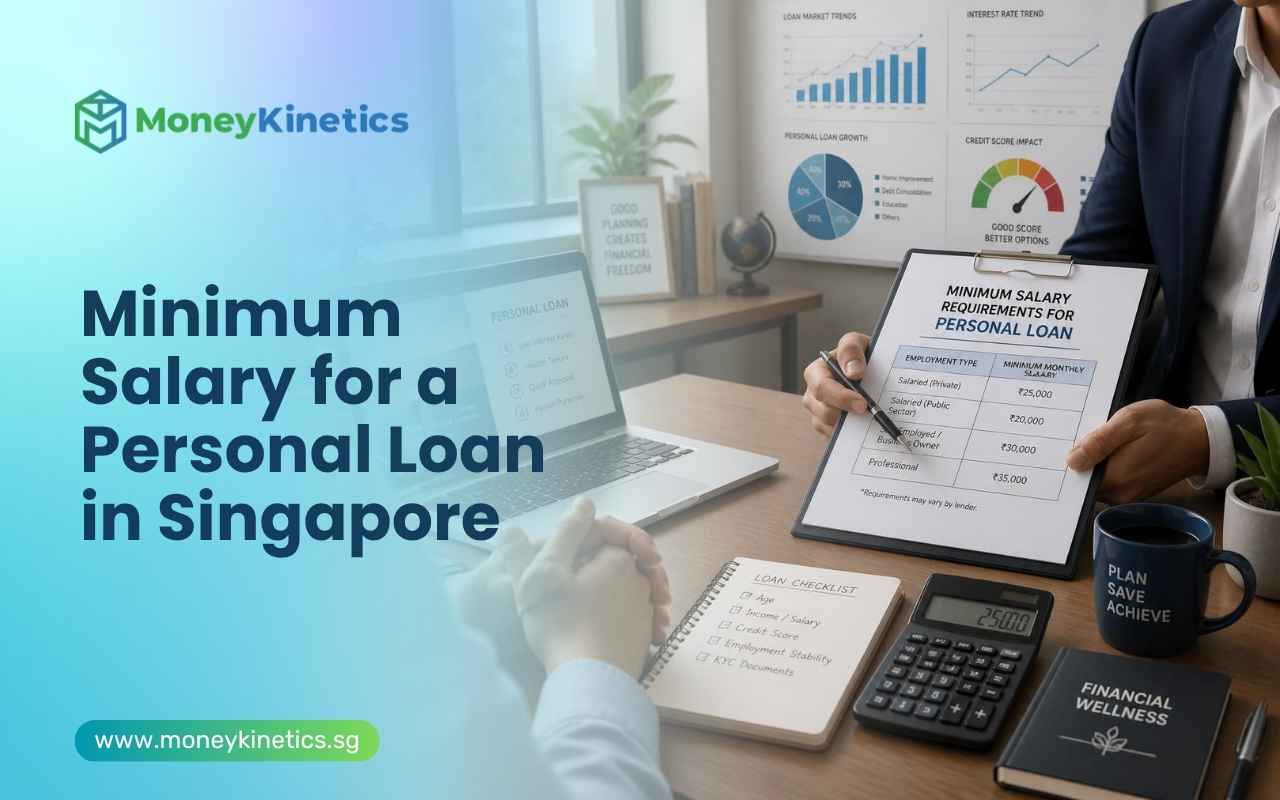
The baseline minimum annual income for a personal loan in Singapore is generally S$20,000 for Singapore Citizens and Permanent Residents applying through most banks. However, this figure is only a starting point. Your actual minimum income requirement depends on your residency status, employment type and which specific bank or lender you approach.
To understand where you stand relative to other borrowers, you may find it useful to read Money Kinetics’ guide on what the median salary in Singapore actually is.
Minimum Salary Requirements by Applicant Type
Income requirements vary depending on whether you’re a Singapore Citizen, Permanent Resident, foreigner, or self-employed. The table below outlines the general baseline requirements:
| Applicant Type | Minimum Annual Income |
|---|---|
| Singapore Citizens & PRs (Salaried) | S$20,000 (some banks such as UOB and Trust Bank require S$30,000) |
| Singapore Citizens & PRs (Self-Employed / Commission-Based) | S$40,000 |
| Foreigners | S$60,000 to S$90,000, depending on the bank |
Self-employed and commission-based borrowers are usually held to a higher income threshold because their earnings can vary month to month, making it harder for a lender to assess consistent repayment ability. If this applies to you, our guide on getting a loan in Singapore if you’re self-employed covers this in more detail.
If you’re a foreigner exploring your options, you may also want to read our guide on personal loans for foreigners in Singapore.
How Your Salary Affects How Much You Can Borrow
Your salary doesn’t just determine whether you qualify. It also affects how much you can borrow. Borrowing limits for unsecured personal loans in Singapore are tiered based on annual income:
| Annual Income | Typical Borrowing Limit |
|---|---|
| S$30,000 and above | Up to 4x to 6x your monthly salary from most banks |
| S$20,000 to S$29,999 | Generally limited to 2x your monthly salary with major retail banks |
| Below S$20,000 (Citizens/PRs) | Up to S$3,000 through a licensed moneylender |
These borrowing caps for licensed moneylenders are set out under the Moneylenders Act and administered by the Ministry of Law’s Registry of Moneylenders. Bank lending limits are governed separately under rules set by the Monetary Authority of Singapore (MAS), since banks and licensed moneylenders fall under two different regulatory frameworks rather than a single shared cap.


Explore Your Personal Loan Options Now
-

Fast, Easy Application Process
-
Secure Match with Trusted Lenders
-
No Hidden Fees, Full Transparency
-
Dedicated Customer Support
💰 Not sure which lender fits your income level? Compare personal loan options across banks and licensed moneylenders based on your salary and eligibility.
What If Your Income Doesn’t Meet the Bank’s Minimum?
If your income falls below a bank’s minimum salary requirement, you’re not automatically excluded from borrowing. Licensed moneylenders are permitted to lend to borrowers with lower incomes, including those earning below S$20,000 a year, subject to the borrowing caps outlined above.

Lending Bee Personal Loan
⭐ Best for fast approval and borrowers who value a smoother digital-first process with 4 branches across Singapore.

Credit 21 Personal Loan
⭐ Best for borrowers who prefer clearer repayment structures and predictable terms.

GS Credit Personal Loan
⭐ Best for borrowers looking for more flexible eligibility assessment.
Compare More Licensed Moneylenders
Review more licensed moneylenders side by side based on approval speed, convenience, and borrower suitability.
Before applying with any lender, it’s worth understanding how licensed moneylenders assess borrowers, since income is only one part of the overall assessment. You can also read our guide on personal loan options if you have a low income for a closer look at what to expect.
Does a Lower Salary Always Mean Rejection?
Not necessarily. A lower salary may mean a smaller loan amount rather than outright rejection, especially if your income is stable and your existing debts are manageable. Lenders generally look at the full picture, including income consistency, employment duration and existing financial commitments, not just the raw salary figure.
If you’re unsure where your income places you relative to others in your age group, our guide on average salary in Singapore by age may help put things in context.
Comparing Bank and Moneylender Salary Requirements
Banks generally set higher minimum salary requirements but may offer larger loan amounts and lower interest rates for qualifying borrowers. Licensed moneylenders have lower income thresholds and more flexible eligibility criteria, but loan amounts are smaller and interest rates are higher, within the legal cap.
For a closer comparison of how these two options differ beyond just income requirements, read our guide on licensed moneylenders versus banks in Singapore. You may also want to check our roundup of best bank personal loans in Singapore if your income meets bank thresholds.
Tips If Your Income Is Close to the Minimum
- Check the specific income requirement of the bank or lender before applying, since thresholds vary
- Keep your income documents (payslips, CPF statements, Notice of Assessment) organised and up to date
- Avoid applying for a loan amount larger than your income can comfortably support
- Consider a licensed moneylender if your income falls below a bank’s minimum threshold
- Use a repayment calculator to check affordability before committing to a loan amount
You can estimate your repayments using Money Kinetics’ personal loan calculator before applying.
FAQ: Minimum Salary for a Personal Loan in Singapore
What is the minimum salary for a personal loan in Singapore?
The baseline minimum is S$20,000 a year for Singapore Citizens and Permanent Residents applying through most banks, though some banks such as UOB and Trust Bank require S$30,000. Self-employed borrowers typically need S$40,000, and foreigners generally need S$60,000 to S$90,000, depending on the bank.
Can I get a personal loan if I earn less than S$20,000 a year?
Yes, licensed moneylenders may still lend to borrowers earning below S$20,000 a year, though the borrowing amount is capped at S$3,000 for Citizens and PRs under this income tier.
Do self-employed borrowers need a higher salary to qualify?
Yes. Self-employed and commission-based borrowers generally need a minimum annual income of S$40,000, higher than the salaried threshold, since their income is considered less predictable.
Why do foreigners need a higher minimum salary than Citizens or PRs?
Banks generally view foreign borrowers as a higher lending risk due to factors such as shorter employment tenure in Singapore, which is why the minimum income requirement is set higher, typically S$60,000 to S$90,000 depending on the bank.
Does a higher salary guarantee loan approval?
No. Meeting the minimum salary requirement makes you eligible to apply, but approval also depends on factors such as credit history, existing debts and overall repayment ability.
Final Thoughts
The minimum salary for a personal loan in Singapore depends on who you’re borrowing from and how you earn your income. Banks generally require S$20,000 to S$30,000 for salaried Citizens and PRs, S$40,000 for self-employed borrowers, and S$60,000 to S$90,000 for foreigners. If your income falls below these thresholds, licensed moneylenders may still be an option, with borrowing limits scaled to your income.
Before applying, it’s worth comparing your options based on your actual income level rather than assuming you don’t qualify. Understanding where you fall within these thresholds can help you choose the right lender and avoid unnecessary rejections.
Related Guides on Loan Eligibility and Income Requirements
- Personal Loan Singapore
- Low Income Personal Loan Singapore
- Self-Employed Loan Singapore
- Personal Loan for Foreigners Singapore Guide
- Licensed Moneylenders vs Banks
- Median Salary Singapore Explained

Yannie Woon
Starting out as a freelance writer, Yannie quickly realised she had a gift for explaining money matters in a way that didn't make people want to tear their hair out. When she's not cracking jokes about compound interest, Yannie enjoys attending industry seminars, engaging with financial experts on social media, and volunteering her time and expertise to help those in need.
Top Picked Articles For You




Ready to Get Your Loan?
Start your journey with a quick, secure, and obligation-free application. Compare rates, pick your best match, and get funded fast.
Compare & Get Matched Instantly
Fast Fund Disbursement


Loan Offers in Just 15 Minutes

No Hidden Fees, No Upfront Costs
