What Are the Rights of Borrowers in Singapore?

Yannie Woon 27 July 2026
Key Takeaways
- Borrowers have the right to receive a clear explanation of the loan terms in a language they understand and a completed copy of the loan contract.
- A licensed moneylender should not retain your NRIC, passport, work pass, ATM card or other personal identification documents.
- Never give a lender your Singpass, internet banking, email or other account passwords.
- Licensed moneylenders may charge no more than 4% interest per month, an administrative fee of up to 10% of the principal and a late fee of up to S$60 for each month of late repayment.
- Late interest is limited to 4% per month and may only be charged on the amount that is overdue.
- The combined interest, late interest, administrative fee and late fees cannot exceed the original loan principal.
- Borrowers should receive a receipt after every repayment and a statement of account at least once every January and July while the loan remains outstanding.
- Licensed moneylenders and their debt collectors may take reasonable steps to recover a debt, but they must not use threats, violence, vandalism or other unlawful conduct.
- Unfair practices and contractual concerns can be reported to the Registry of Moneylenders. Harassment, threats or violence should also be reported to the Police.
- Borrower protections do not remove the obligation to repay a valid loan. Contact the lender early if you are unable to meet the repayment schedule.
Taking a loan creates a legally binding financial obligation, but it does not mean that a borrower must accept misleading information, unlawful charges or improper treatment. Singapore’s moneylending rules provide important protections covering loan contracts, borrowing costs, personal documents, repayment records and debt collection.
Understanding borrower rights Singapore residents can rely on helps you recognise whether a lender is following the required process. It can also help you identify warning signs before signing a contract and decide what to do when something appears incorrect.
This guide focuses primarily on borrowers dealing with licensed moneylenders. Banks and other financial institutions are regulated under different rules, so the limits discussed below should not automatically be applied to every type of credit provider.
Table of Contents
What Do Borrower Rights Mean in Singapore?
Borrower rights are the legal and procedural protections that apply when a person applies for, receives or repays a loan. For licensed moneylender loans, these protections are established through the Moneylenders Act, subsidiary rules and requirements administered by the Registry of Moneylenders.
They cover several parts of the borrowing process:
- How a licensed moneylender may advertise its services
- How your identity and application should be verified
- What the lender must explain before you sign
- Which documents you should receive
- How much interest and fees may be charged
- How repayments should be recorded
- How debt collection should be conducted
- Where you can report unfair or unlawful conduct
These protections do not guarantee that an application will be approved. They also do not cancel your responsibility to make repayments after entering into a valid loan agreement.
Your Rights Before Taking a Loan

Right to Deal With a Verifiable Licensed Moneylender
Before providing personal information or visiting an office, check the lender against the official Registry of Moneylenders list. Confirm that the business name, website, telephone number and approved office address match the Registry’s records.
A website, company registration or professional-looking advertisement does not by itself prove that a lender is licensed. The official Registry list should be your primary point of verification.


Explore Your Personal Loan Options Now
-

Fast, Easy Application Process
-
Secure Match with Trusted Lenders
-
No Hidden Fees, Full Transparency
-
Dedicated Customer Support
The Money Kinetics guide to choosing a licensed moneylender explains other factors to compare, including borrowing costs, contract terms and repayment arrangements.
Protection From Prohibited Loan Advertising
Licensed moneylenders may advertise only through their own websites, business or consumer directories, and advertisements displayed within or on the exterior of their approved business premises.
They are not permitted to solicit borrowers through SMS, WhatsApp, Telegram, unsolicited calls, emails, flyers or social media messages. Do not respond to a message merely because the sender claims to represent a licensed company.
If you receive an unsolicited loan offer, independently verify the business through the Registry. Never transfer a processing fee before visiting the lender’s approved office and completing the required checks.
Right to Proper Identity Verification
A licensed moneylender must verify a borrower’s identity at its approved place of business before granting the loan. Although an initial enquiry or application may begin online, the entire licensed moneylender process cannot be completed remotely.
Be cautious if someone claims that a loan can be confirmed and disbursed entirely through a messaging app, telephone call or email. Read the guide to how licensed moneylender approval works for a clearer explanation of the required process.
Your Right to Understand the Loan Contract
A licensed moneylender must explain the loan terms in a language you understand. You should also receive a completed copy of the Note of Contract, which sets out the terms and conditions governing the loan.
Before signing, check that the contract clearly states:
- The principal amount borrowed
- The interest rate
- The administrative fee
- The repayment period
- The amount and due date of each instalment
- The late interest rate
- The late payment fee
- The total repayment obligations
- Any security, guarantee or property-related conditions
Do not sign a blank or incomplete contract. You should also compare the written terms with any explanation or quotation previously provided by the lender. If the figures differ, ask for clarification before signing.
You are entitled to take time to understand the offer. A lender should not pressure you to sign before you have read the contract or prevent you from asking questions about its terms.
Your Right to Limits on Interest and Fees
Singapore’s licensed moneylending rules limit the interest and fees that may be imposed on a loan.
| Charge | Maximum Permitted Amount |
|---|---|
| Regular interest | Up to 4% per month |
| Administrative fee | Up to 10% of the loan principal when the loan is granted |
| Late interest | Up to 4% per month on the amount that is overdue |
| Late fee | Up to S$60 for each month of late repayment |
| Legal costs | Legal costs ordered by a court following a successful recovery claim |
| Total borrowing-cost cap | Interest, late interest, administrative fees and late fees combined cannot exceed the loan principal |
Regular interest must be calculated on the outstanding principal after principal repayments have been taken into account. Late interest can only be applied to the instalment or amount that has become overdue, rather than the entire outstanding loan when the remaining instalments are not yet due.
For example, if an instalment of S$500 is overdue, late interest should be calculated on that overdue S$500 rather than every future instalment under the loan.
These limits apply to licensed moneylenders. They should not be confused with the interest structures used for bank loans or credit cards. To understand how different quoted rates affect borrowing costs, read about the effective interest rate versus the advertised interest rate.
Your Right to Legal Unsecured Borrowing Limits
Licensed moneylenders must also observe the total unsecured borrowing limits prescribed for borrowers. The limit applies across all licensed moneylenders combined, not separately to every lender.
| Annual Income | Singapore Citizens and PRs | Foreigners Residing in Singapore |
|---|---|---|
| Less than S$10,000 | Up to S$3,000 | Up to S$500 |
| S$10,000 to less than S$20,000 | Up to S$3,000 | Up to S$3,000 |
| S$20,000 or more | Up to six times monthly income | Up to six times monthly income |
The applicable limit is a regulatory maximum, not an amount that a borrower is automatically entitled to receive. A lender may approve a lower amount or reject an application after assessing income, existing commitments, credit history and repayment ability.
Your Right to Keep Your Identification and Passwords
A licensed moneylender should not retain your original NRIC, passport, driving licence, work permit, employment pass, ATM card or other personal identification document.
The lender may need to inspect an original document to verify your identity, but it should be returned after the necessary check. You should not leave an ATM card with the lender as security for a loan.
A lender must not ask for passwords to your:
- Singpass account
- Internet or mobile banking
- Email account
- Digital wallet
- ATM or debit card
- Other personal online accounts
Where digital information is required, use an authorised process and enter your own credentials without disclosing the password to the lender. Requests for account passwords are a serious warning sign.
Your Right to Receive the Correct Loan Amount
After approval, check that the amount disbursed is consistent with the contract. A licensed moneylender may deduct an administrative fee of up to 10% of the principal when the loan is granted, but it should not withhold other parts of the principal without a lawful basis.
For example, if the principal is S$5,000 and the administrative fee is 10%, the permitted upfront deduction would be no more than S$500. The borrower should receive the remaining S$4,500, subject to the terms of the completed contract.
Ask for a clear breakdown before leaving the lender’s office. Do not proceed if the amount received, fee charged or repayment schedule differs from the contract.
Your Right to Repayment Records and Account Statements
Proper records help borrowers track their balances and provide evidence if a dispute occurs. After taking a loan, you should receive:
- A receipt whenever you make a repayment
- A statement of account at least once every January and July while the loan remains outstanding
- A clear record of the payment amount, payment date and remaining balance
Check every receipt before leaving the office or closing the payment confirmation. Ensure that your name, the amount paid, the payment date and the account details are correct.
Keep the loan contract, receipts, bank transfer confirmations, statements and communications until the loan has been fully settled. The Registry’s professional service guidance also states that a borrower should receive confirmation when all dues have been paid and the loan account has been closed.
Your Rights During Debt Collection
A missed repayment does not erase the debt, and a lender may take reasonable steps to recover money owed. This can include contacting the borrower, issuing a letter of demand or taking legal action to enforce the contract.
However, debt collection must remain within the law. A moneylender or debt collector must not use conduct such as:
- Violence or criminal force
- Threatening words or behaviour
- Vandalism or damage to property
- Abusive or vulgar language
- Stalking or persistent harassment
- Publicly shaming a borrower on social media
- Displaying information that publicly reveals the borrower’s debt
- Improperly disclosing detailed loan information to unrelated third parties
A visit to a home or workplace is not automatically unlawful. Whether collection conduct amounts to harassment or another offence depends on the circumstances. If threats, violence, vandalism or harassment occur, preserve the evidence and make a Police report.
If you have missed a payment, read about what happens after missing a loan repayment and contact the lender before additional costs accumulate.
What Responsibilities Do Borrowers Still Have?
Borrower protections work alongside the borrower’s contractual responsibilities. Once you sign a valid loan agreement, you are legally obliged to comply with its terms.
Your main responsibilities include:
- Providing accurate information during the application
- Reading and understanding the contract before signing
- Using the correct payment channel
- Making each repayment by its due date
- Keeping evidence of every payment
- Updating the lender when relevant contact information changes
- Contacting the lender early if repayment difficulties arise
A disagreement with the lender does not automatically suspend the repayment schedule. Obtain appropriate legal advice if you believe a contractual term is unlawful or substantially unfair.
What Should You Do If Your Rights Are Breached?
Begin by gathering evidence. Keep copies of the contract, application form, receipts, statements, bank records, messages, screenshots and details of conversations. Record the date, time, location and names of the people involved where possible.
Depending on the issue, you can take the following steps:
- Raise the issue with the lender: Ask for a written explanation or correction where the matter involves an account balance, receipt, payment record or contractual misunderstanding.
- Report the lender to the Registry: Complaints involving unfair practices, contract issues or possible offences can be lodged through the Registry of Moneylenders.
- Make a Police report: Contact the Police if debt collection involves harassment, threats, violence, vandalism or other suspected criminal conduct.
- Consider legal advice: The Registry states that borrowers affected by unfair practices may consider pursuing the matter in court under the Consumer Protection (Fair Trading) Act. A court may grant relief depending on the facts.
- Seek debt assistance: If the problem is an inability to repay, contact the lender or an appropriate social service or credit counselling organisation to discuss available options.
The Registry investigates regulatory complaints but does not negotiate repayment arrangements on a borrower’s behalf. Restructuring or settlement remains a contractual matter between the borrower and lender.
What If You Cannot Afford the Repayments?
Contact the lender as early as possible instead of ignoring reminders. Explain your circumstances accurately and ask whether a mutually acceptable repayment arrangement can be considered. A lender is not required to accept every proposal, but early communication may provide more options than waiting until several instalments are overdue.
Before agreeing to a revised arrangement, ask for the terms in writing and check:
- The revised instalment amount
- The new repayment dates
- Any interest or fees that continue to apply
- The revised loan tenure
- The total remaining amount repayable
- Whether the arrangement replaces or changes the original contract
Avoid taking another short-term loan merely to make the next repayment unless the new arrangement has been assessed carefully and genuinely improves your financial position. The guide to negotiating debt repayment in Singapore explains how to prepare before approaching a creditor.
Borrower Rights Checklist Before You Sign
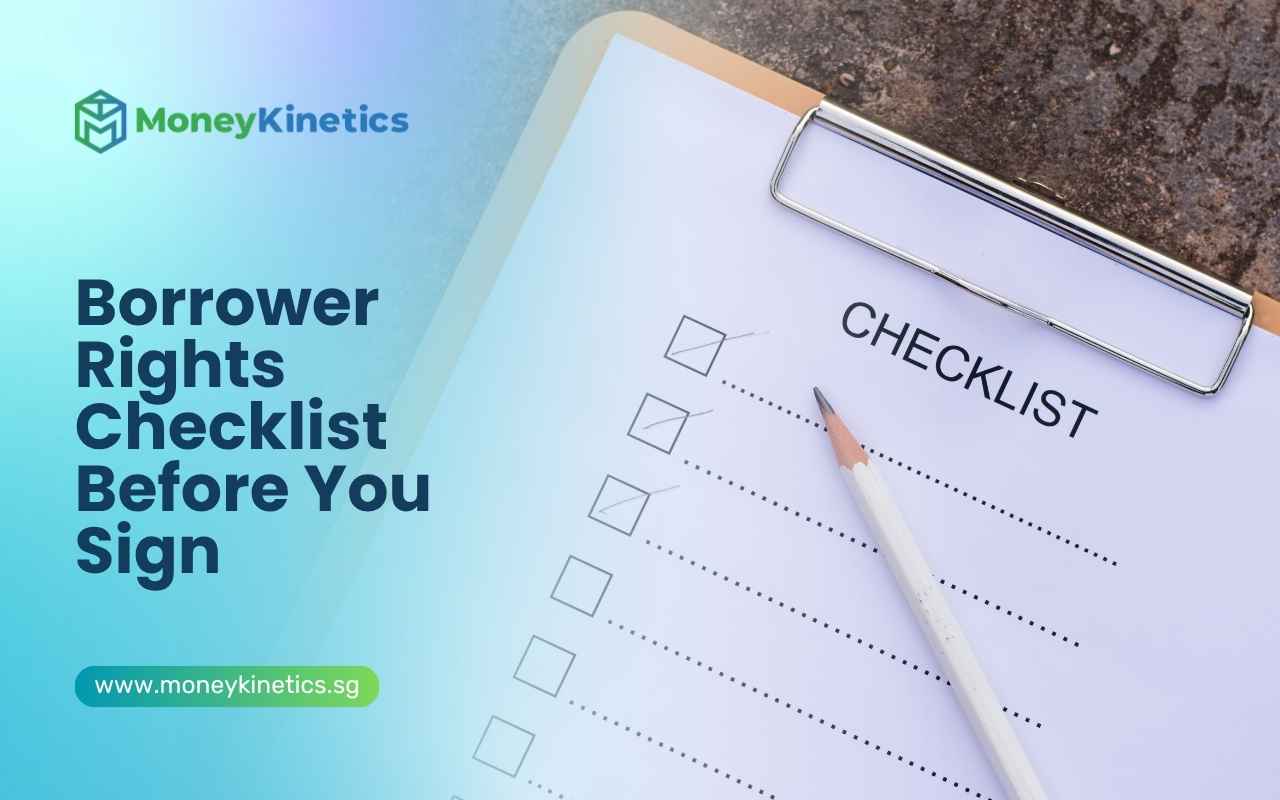
- Confirm the lender appears on the official Registry list.
- Check that the website, telephone number and office address match the Registry’s records.
- Attend the lender’s approved premises for identity verification.
- Request an explanation of every interest rate, fee and repayment obligation.
- Read the completed contract in a language you understand.
- Do not sign blank or incomplete documents.
- Do not hand over your Singpass, banking or account passwords.
- Do not allow the lender to retain your original identification or ATM card.
- Confirm the amount you will receive after the permitted administrative fee.
- Keep a copy of the contract, repayment schedule and application form.
- Borrow only what you need and can reasonably repay.
For a broader comparison of lenders and their services, visit the Money Kinetics guide to the best licensed moneylenders in Singapore. Inclusion in a comparison does not guarantee approval or mean that every loan will be suitable for your circumstances.

Lending Bee Personal Loan
⭐ Best for fast approval and borrowers who value a smoother digital-first process with 4 branches across Singapore.

Credit 21 Personal Loan
⭐ Best for borrowers who prefer clearer repayment structures and predictable terms.

GS Credit Personal Loan
⭐ Best for borrowers looking for more flexible eligibility assessment.
Compare More Licensed Moneylenders
Review more licensed moneylenders side by side based on approval speed, convenience, and borrower suitability.
Compare Loan Options Through Money Kinetics
Understanding your rights is only one part of making a responsible borrowing decision. You should also compare the interest, fees, repayment period, monthly instalments and total amount repayable.
Submit a loan enquiry through Money Kinetics to review available options based on your circumstances. Approval is not guaranteed, and you should borrow only an amount you can reasonably repay.
FAQs About Borrower Rights in Singapore
What rights do borrowers have when dealing with a licensed moneylender?
Borrowers have the right to receive a clear explanation of the loan terms in a language they understand, a completed copy of the loan contract, receipts for repayments and regular statements of account. Licensed moneylenders must also comply with legal limits on interest and fees.
Can a licensed moneylender keep my NRIC or ATM card?
No. A licensed moneylender should not retain your NRIC, passport, work pass, driving licence, ATM card or other personal identification documents. Original documents may be inspected for verification but should be returned to you.
Can a licensed moneylender ask for my Singpass password?
No. You should never disclose your Singpass password, internet banking password, email password, ATM PIN or other account credentials to a lender. Enter your own credentials only through authorised and secure services.
What documents should I receive after making a loan repayment?
You should receive a receipt for every repayment and check that the name, payment amount and date are correct. While the loan remains outstanding, you should also receive a statement of account at least once every January and July.
Where can I complain about a licensed moneylender?
You can lodge a complaint with the Registry of Moneylenders and provide supporting evidence such as contracts, receipts, statements and messages. If the matter involves harassment, threats, violence or vandalism, you should also make a Police report.
Final Thoughts
Borrower rights in Singapore protect people from unclear contracts, excessive licensed moneylender charges, improper handling of identification documents and unlawful debt collection practices. Knowing these protections can help you recognise problems before they become more serious.
However, borrower rights do not make a signed loan optional. Read every term carefully, keep complete repayment records and contact the lender early if you expect difficulty paying.
Before borrowing, verify the lender through the official Registry, compare several suitable options and calculate whether the instalments fit your budget after essential expenses. A legitimate loan should have transparent terms, proper documentation and a repayment plan you can reasonably manage.
Related Guides
- Best Licensed Moneylenders in Singapore
- Complete Guide to Licensed Moneylenders
- How to Choose a Licensed Moneylender
- How to Identify Loan Scams in Singapore
- What Happens If You Miss a Loan Repayment?

Yannie Woon
Starting out as a freelance writer, Yannie quickly realised she had a gift for explaining money matters in a way that didn't make people want to tear their hair out. When she's not cracking jokes about compound interest, Yannie enjoys attending industry seminars, engaging with financial experts on social media, and volunteering her time and expertise to help those in need.
Top Picked Articles For You



Ready to Get Your Loan?
Start your journey with a quick, secure, and obligation-free application. Compare rates, pick your best match, and get funded fast.
Compare & Get Matched Instantly
Fast Fund Disbursement


Loan Offers in Just 15 Minutes

No Hidden Fees, No Upfront Costs
